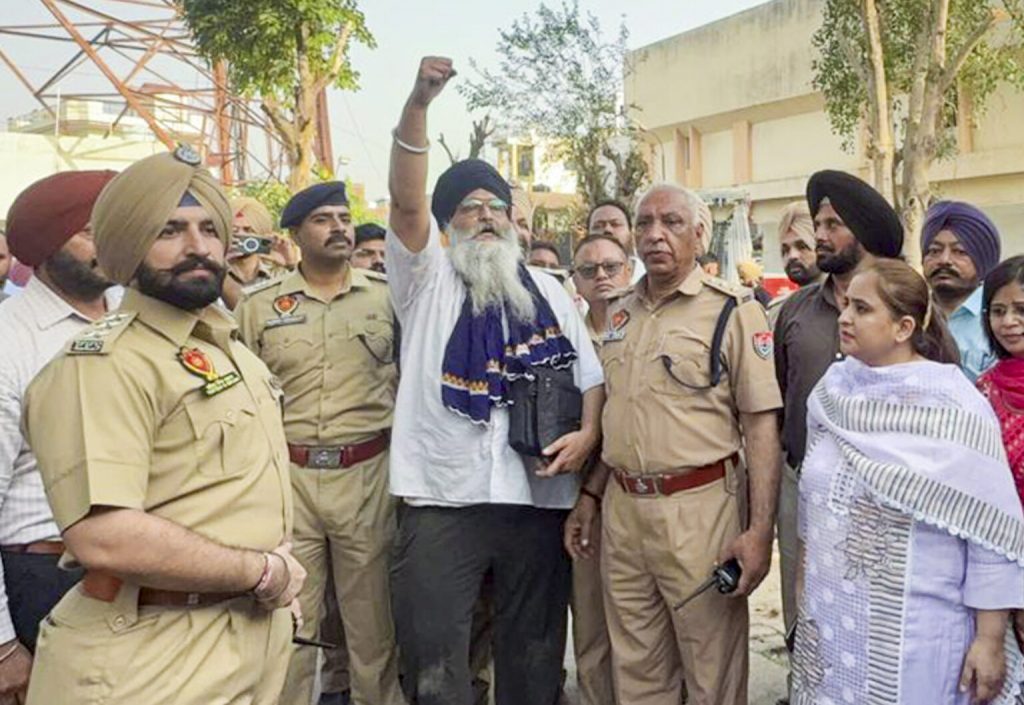
SAMANA (PATIALA), Apr 24: Activist Gurjeet Singh Khalsa, who had been sitting atop a 400-foot BSNL tower for about 560 days demanding stricter laws against sacrilege incidents in Punjab, was finally brought down on Friday morning, officials said.
The development brought to an end a dramatic protest that began when Khalsa (43) climbed atop the tower in Samana near Patiala on October 12, 2024, demanding stringent punishment for the sacrilege of the Guru Granth Sahib.
He was brought down by a team comprising firemen, police and civil officials with the help of a specialised crane-lift, a fire official from Patiala said.
After he descended amid ‘Sikh Jaikara’ and ‘Jo Bole So Nihal, Sat Sri Akal’ chants, Khalsa was taken to a hospital in an ambulance for a medical checkup, with his supporters showering flower petals on him.
“We have won,” the activist from Kheri Nagaian village in Patiala district said as he stepped onto the ground.
“By the Guru’s grace, I have come down safely after 18 months and 12 days. I thank the Punjab government,” Khalsa said, expressing his gratitude to Chief Minister Bhagwant Mann and Assembly Speaker Kultar Singh Sandhwan for enacting an anti-sacrilege law.
Khalsa also thanked the local administration for bringing him down safely. The activist decided to end his protest after the Punjab government recently notified the anti-sacrilege law – the Jaagat Jot Sri Guru Granth Sahib Satkar (Amendment) Act, 2026 – which proposes stricter punishment, including life imprisonment and a fine of up to Rs 25 lakh, for any act of sacrilege against the Guru Granth Sahib.
The protest drew attention across Punjab due to its unique nature and the extreme conditions endured by Khalsa, who remained atop the tower through harsh winter and scorching summer months.
He was sent essential supplies via ropes.
He stayed in a makeshift tarpaulin shelter atop the tower, using a polythene bag to relieve himself.
Harinderpal Singh, an assistant fire officer in Patiala, said, “We conducted the operation with the help of the district administration and police. Firemen, a sub-officer and two station officers were involved in it.
“As we had to reach a considerable height to bring him down, we used chains and links, a safety belt and a turntable ladder.” As Khalsa was brought down using a safety belt, a fireman was stationed below to ensure his safety.
“First, he was brought down to a platform built above the ground level, after which we used the turntable ladder to get him down,” the fire officer said. A farmer by profession, Khalsa’s core demand was the introduction of stricter legal provisions against the sacrilege of the Guru Granth Sahib.
The Jaagat Jot Sri Guru Granth Sahib Satkar (Amendment) Act, 2026, proposes stricter punishments to deter incidents of ‘beadbi’ (sacrilege) and uphold the sanctity of the Guru Granth Sahib. According to the law, any person who commits sacrilege shall get a minimum of seven years’ imprisonment, extendable to up to 20 years, along with a fine of Rs 2 lakh to Rs 10 lakh.
Any person who, in a criminal conspiracy, commits sacrilege with the intention of disrupting peace or communal harmony shall get a minimum 10-year sentence, extendable to up to life imprisonment, along with a fine of Rs 5 lakh, which may go up to Rs 25 lakh, the law says.