NEW DELHI, Sep 14: China significantly reduced the deployment of its People’s Liberation Army (PLA) forces along India’s northern borders during 2025, even as the Indian Army maintained a “robust” posture across all sectors of the Line of Actual Control (LAC), while Pakistan continued to pose a major security challenge through terrorism, infiltration and ceasefire violations in Jammu and Kashmir, according to the Ministry of Defence’s Annual Report 2025-26.
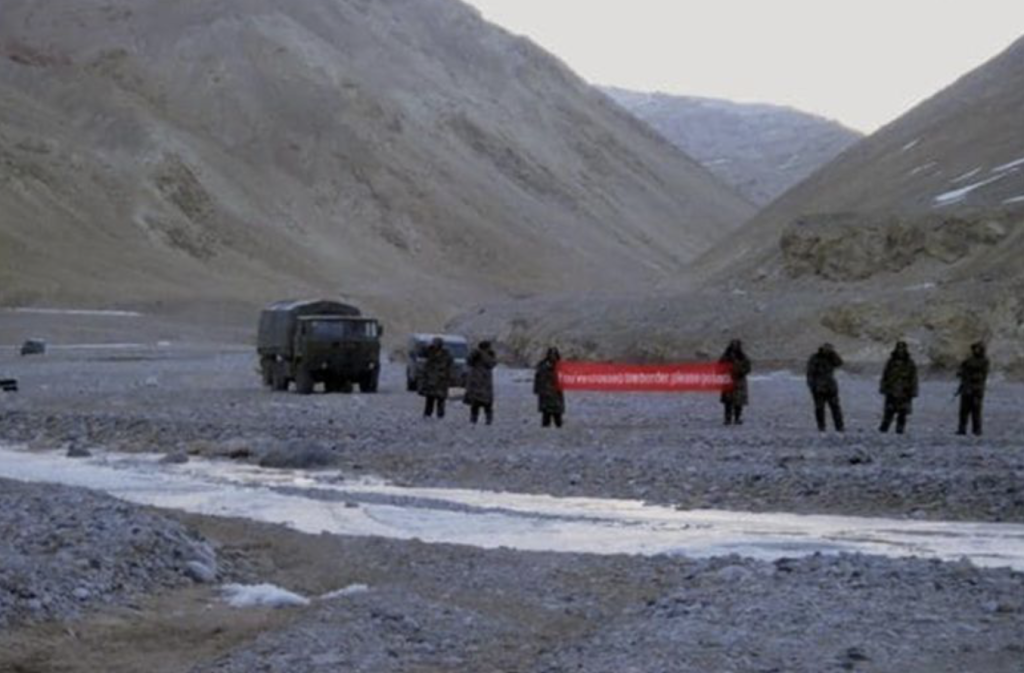
The report said there is a “significant reduction in deployment of People’s Liberation Army (PLA) Forces opposite Northern Borders”, with forces equivalent to about 10 Combined Arms Brigades deployed in areas along the LAC and traditional training areas.
Despite the drawdown, the Indian Army remained “robust, well poised and prepared to deal with any emerging contingency”, underscoring that the reduction in Chinese deployment has not led New Delhi to lower its operational preparedness.
The report said sustained political, diplomatic and military engagements with China during the year facilitated “positive developments along the Northern Borders, leading to stability”. The 33rd and 34th meetings of the Working Mechanism for Consultation and Coordination were held in March and July 2025, while talks between the Special Representatives on the boundary question resumed, with rounds held in December 2024 and August 2025.
The easing of tensions was also reflected in Prime Minister Narendra Modi’s visit to China for the Shanghai Cooperation Organisation summit in Tianjin in August 2025 and the 23rd Corps Commander Level Meeting in Eastern Ladakh on October 25-26. Border Personnel Meetings with the PLA also continued in a “cordial and friendly environment”, the report said.
The northern border situation has remained among India’s most sensitive security theatres since the 2020 military standoff in eastern Ladakh, which triggered sustained troop deployments and a major build-up of military infrastructure on both sides. The latest assessment indicates that while the immediate military posture has eased, the Indian Army continues to maintain substantial preparedness against any renewed contingency along the LAC.
On the western front, however, the Army’s assessment remains considerably more pointed, directly identifying Pakistan as a key driver of the continuing security challenge in Jammu and Kashmir.
The report said 19 terrorists were neutralised in counter-terror operations in J&K during 2025, including eight Pakistani terrorists, accounting for around 40 per cent of the total. “The figure clearly indicates role of Pakistan in waging proxy war in the UT of J&K,” the report said, explicitly linking the presence of Pakistani terrorists to Islamabad’s continuing proxy campaign.
The Pakistani role was further evident along the Line of Control, where the Army recorded six infiltration attempts during 2025 and neutralised 12 Pakistani terrorists attempting to infiltrate into Jammu and Kashmir. While infiltration attempts declined from previous years, the report said the threat has been evolving, with terrorist activities increasingly shifting towards the International Border and involving narcotics and “war like stores”.
Pakistan’s military pressure along the LoC also increased sharply during 2025. The Army recorded 163 ceasefire violations, compared with just two in 2024. As many as 124 violations occurred during Operation Sindoor, launched following the April 22 Pahalgam terror attack in which Pakistan-based terrorists killed tourists.
The situation along the LoC stabilised considerably following DGMO-level talks between India and Pakistan on May 10 and 12. However, the annual report cautioned that the apparent calm should not be mistaken for an end to the threat, stating that “unpredictability continues”.
At the same time, the Army’s assessment points to a significant erosion of Pakistan’s ability to sustain a local support base for terrorism in Jammu and Kashmir. Only one local youth joined terrorist ranks in 2025, with the report saying that young people had “abandoned the path of violence” and were increasingly benefiting from government schemes and policies, thereby “discrediting Pakistan’s narrative of home-grown terrorism”.
“The awaam (public) has chosen to follow the path of development and has been actively participating in large numbers in all government and IA run initiatives,” the report said. This, according to the Army, has resulted in reduced violence, scaled-down protests and “zero incidents of stone pelting”.
The assessment presents a stark contrast between the declining local support for militancy and the continuing external threat. While the local population is increasingly moving away from violence, Pakistan-backed networks continue to attempt infiltration and sustain terrorist activity, suggesting that the external push behind the proxy war remains intact.
The threat is also increasingly extending beyond conventional infiltration and small-arms movement. Along the International Border in Jammu and Kashmir, Punjab and Rajasthan, the Army recorded 863 drone intrusions, bringing a new dimension to Pakistan-linked attempts to smuggle narcotics, weapons and other war-like stores into India. Security forces brought down 237 drones during the year.
Despite the Pahalgam attack and the escalation during Operation Sindoor, the Army said the improving security environment was reflected in increased civilian activity in J&K. The union Territory recorded 23 million tourist visits and 4.13 lakh pilgrims for the Shri Amarnath Yatra in 2025, indicating growing public confidence in the security situation.