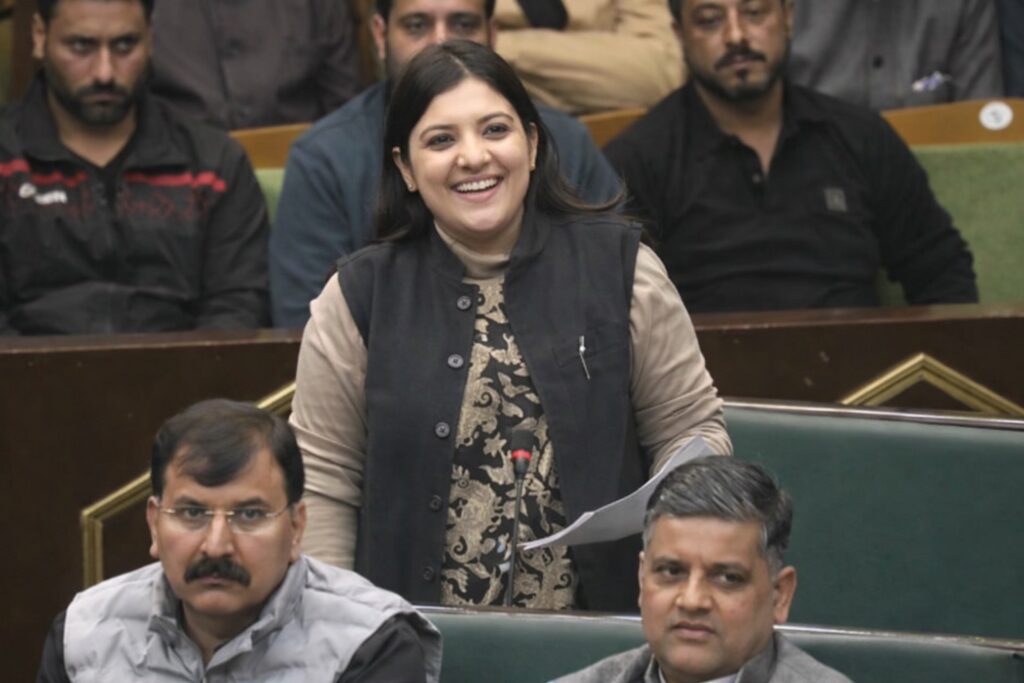
JAMMU: Bharatiya Janata Party (BJP) MLA from Nagrota, Devyani Rana, on Saturday made a poised and impactful maiden address in the Jammu and Kashmir Legislative Assembly, announcing her arrival as a confident legislator while invoking the legacy of her late father and veteran leader Devender Singh Rana.Participating in the general discussion on the Budget 2026–27, presented by the Chief Minister on February 6, Devyani combined emotional remembrance with sharp statistical scrutiny, drawing appreciation from both treasury and opposition benches.
As Speaker Abdul Rahim Rather announced her name, MLAs across party lines welcomed her with desk-thumping applause, with the Chair urging members to encourage the first-time legislator.
“I rise today with a heart that is both heavy and hopeful. This is my maiden address in this august House,” Devyani said, triggering another round of applause.
Remembering her father, she said she stood not merely to occupy a seat, but to honour a legacy of public service.
“Today I speak as a representative of the proud people of Nagrota. I begin by paying my most reverential homage to my father, legislator par excellence Devender Singh Rana Sahib — a leader whose bond with the people was perpetual and transcendent, and whose life was cut cruelly short soon after the people’s mandate,” she said.
Maintaining momentum, she asserted that his ideals continue to guide her commitment to serve the constituency “with the same sincerity and resolve”.
At the outset, Devyani welcomed the Union Government’s allocation of ₹43,290 crore for Jammu and Kashmir in 2026–27, thanking Union Finance Minister Nirmala Sitharaman for an increase of nearly ₹2,000 crore over the previous year.
However, she raised serious concerns over the Disaster Management, Relief and Rehabilitation Department (DMRRD) allocations, pointing out a sharp decline in capital expenditure.
“The capital expenditure estimates stood at ₹719 crore in 2025–26, revised down to ₹448 crore, and further reduced to ₹350.76 crore in 2026–27 — almost half of last year’s estimate,” she said, calling the reduction alarming in a year marked by unprecedented rainfall and devastation, particularly in Nagrota.
She cited tragic incidents, including the death of three-year-old Mahi of Shwap Panchayat in a landslide and 28-year-old Shamsher Ali, swept away by floodwaters.
“These names represent lives lost across Jammu division. Jammu and Kashmir is earthquake-prone, landslide-prone, flood-prone and fire-prone. Preparedness is not optional; it is a moral imperative,” she asserted, calling for greater investment in resilient infrastructure, early warning systems and flood management.
Raising the issue of equity in resource distribution, Devyani recalled flood-related destruction in Jammu — collapsed houses, damaged bridges, stranded students and massive evacuations.
“We are not saying that losses of apple boxes should not be counted. We are saying that these losses pale before homes lost, land subsidence and lives lost in Jammu. There can be no comparison,” she said, urging equitable rebuilding in the most affected areas.
Turning to education, which she described as “the great equaliser”, Devyani flagged a reduction of nearly ₹194 crore in capital expenditure for 2026–27 compared to revised estimates of the current year, and a ₹75 crore cut in revenue expenditure.
“Are we adequately prepared to fill vacancies through fresh recruitment of teachers and lecturers? What about sanitation workers and guards in schools?” she asked.
She also termed the reduced budget for the Power Development Department as “deeply concerning” and questioned whether free bus services for persons with disabilities announced in the budget were backed by accessible infrastructure.
“Mere repackaging of central schemes is not enough,” she cautioned, pressing for accountability, transparency and region-sensitive planning.