
JAMMU: Chief Minister Omar Abdullah on Wednesday called for accelerating Jammu and Kashmir’s transition towards clean energy, ensuring time-bound completion of key projects and optimising renewable energy infrastructure to deliver tangible benefits to the people.
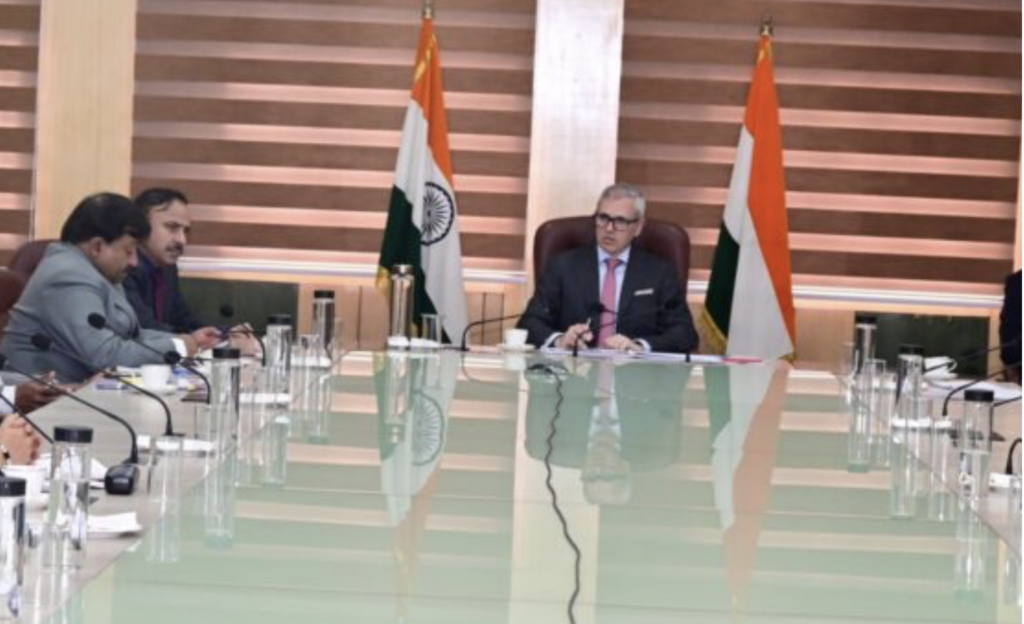
Chairing a review meeting of the Science and Technology Department at the Civil Secretariat, the Chief Minister assessed the progress of major initiatives, institutional activities and ongoing projects. He stressed the need to remove implementation bottlenecks while strengthening research, innovation and scientific outreach.
The meeting was attended by Advisor to the Chief Minister Nasir Aslam Wani, Chief Secretary Dr. Sajjan Singh Yadav, Additional Chief Secretary to the Chief Minister Dheeraj Gupta, Additional Chief Secretary Finance Shailendra Kumar, Administrative Secretary Science and Technology Babila Rakwal and other senior officers.
At the outset, Babila Rakwal presented an overview of the mandate, achievements, ongoing projects and future roadmap of the Jammu and Kashmir Science, Technology and Innovation Council (JKSTIC) and the Jammu and Kashmir Energy Development Agency (JAKEDA).
Reviewing progress under the PM Surya Ghar: Muft Bijli Yojana, the Chief Minister was informed that 9,025 government buildings had been solarised under the CAPEX mode, with a cumulative installed capacity of 96.10 MW. He directed the department to accelerate the solarisation of the remaining government buildings and resolve inter-departmental issues concerning unified billing, adoption of Virtual Net Metering benefits by DISCOMs and conversion of single-phase connections into three-phase connections for solar plants of 10 kW and above.
Emphasising the need to diversify the renewable energy mix, Omar Abdullah called for exploring viable wind energy opportunities alongside faster expansion of solar power. He reviewed the department’s 2030 vision, which envisages 500 MW of Solar PV capacity, 100 MW of Small Hydro capacity and 5 MW across wind, hydrogen, biomass and Battery Energy Storage Systems.
He also directed officials to explore solar energy potential in water bodies under the PM Surya Sarovar Yojana and expedite the Model Solar Village initiative across all 20 districts.
The Chief Minister called for strict adherence to project timelines and directed the department to accelerate the Industrial Biotechnology Park at Handwara, the Sub-Regional Science Centre and Science Innovation Dissemination Centre at Rajbagh, Srinagar, and the 240 kW Solar Agro-Photovoltaic pressure irrigation project at Patyari Cluster in Samba.
Reviewing 62 Small Hydro Power projects with a combined capacity of 135.15 MW in the development pipeline, he called for coordinated efforts to secure forest clearances and no-objection certificates within stipulated timelines to prevent execution delays.
He also stressed the timely operationalisation of the Industrial Biotechnology Parks at Ghatti, Kathua, and Handwara, along with the proposed Centre of Innovation and Excellence. The completed biotechnology park at Ghatti, he said, should be put to optimum commercial and research use to promote innovation, entrepreneurship and employment generation.
Calling for the full operationalisation of the Sub-Regional Science Centre in Srinagar, the Chief Minister directed officials to attract visitors through interactive scientific exhibitions. He also emphasised strengthening science outreach among young people and developing facilities such as planetariums to make scientific learning more engaging and accessible.
On proposed Bio-Farms for medicinal and aromatic plants, Omar Abdullah stressed the need to ensure commercial viability and establish stronger market linkages to create sustainable livelihood opportunities.
The meeting was informed that JAKEDA had installed 4,891 solar agricultural pumps under PM-KUSUM against a target of 5,000, achieving 97.8 per cent of the allocated target. A 30 kW solar-powered electric vehicle charging station has also been commissioned at the Islamic University of Science and Technology (IUST), Awantipora.
Officials further informed the meeting that the Jammu and Kashmir Compressed Bio-Gas Policy 2026 had been notified to promote circular energy initiatives under the GOBARdhan programme.
Under the RESCO mode, solarisation of 8,000 government buildings through JAKEDA, with a targeted capacity of 152 MW, and another 1,500 buildings through NHPC, with a target of 23 MW, has been proposed. A Power Purchase Agreement for 8 MW has already been signed for the Health and Medical Education Department in Jammu
On the science and innovation front, JKSTIC highlighted several major events organised during 2026, including the J&K Medical Science Congress at SKIMS/SKICC, J&K Science Congress at IUST, J&K Agriculture Science Congress at SKUAST-Kashmir and J&K Women Science Congress at Government College for Women, Parade, Jammu.
Upcoming initiatives include Science on Wheels, a mobile exhibition bus aimed at taking scientific awareness beyond institutional settings, the J&K Children’s Science Congress, research and development in assistive technologies for persons with disabilities, location-specific health research and financial assistance for patents and intellectual property rights.
Concluding the review, the Chief Minister called for strengthening the research and innovation ecosystem, expanding scientific outreach and ensuring that research and technological interventions translate into practical solutions, entrepreneurship and economic opportunities for the people of Jammu and Kashmir.