

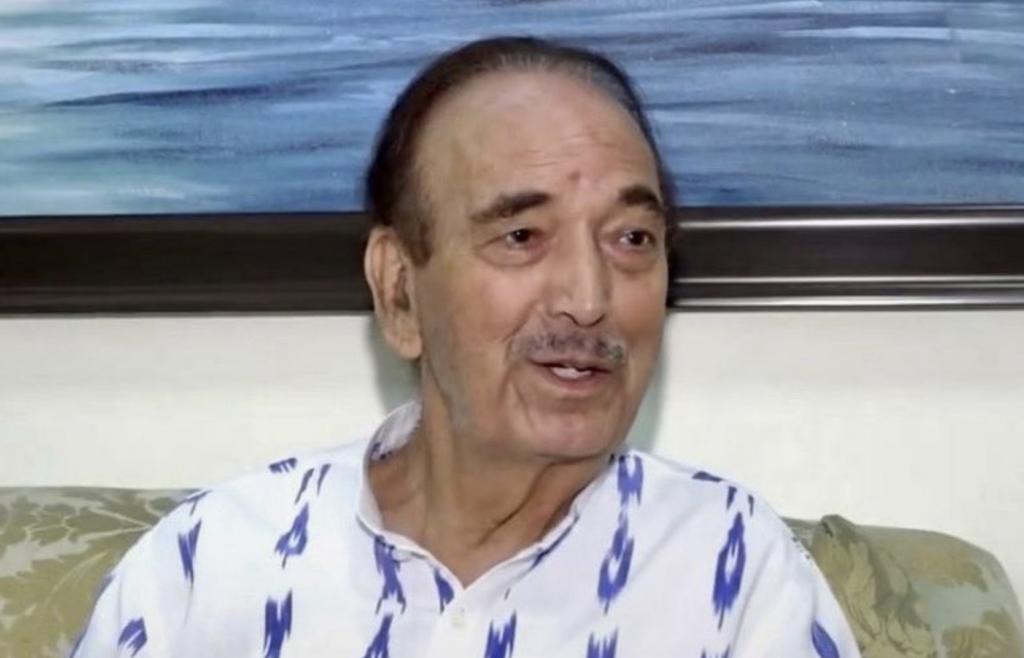
JAMMU, Oct 25: Former Jammu and Kashmir Chief Minister and former Leader of Opposition in Rajya Sabha, Ghulam Nabi Azad today said that Pakistan has never been a friend of the people of J&K, because the neighbouring country only abetted terrorism, violence and bloodshed to Jammu and Kashmir.
“Since the partition of 1947, the people of the region have repeatedly suffered because of Pakistan’s policies, actions and continued interference. Rather than contributing to peace, prosperity and development, Pakistan’s support for cross-border terrorism and militants’ infiltration, has caused immense sufferings, loss of innocent lives and prolonged instability in the region,” Azad told media-persons while reacting to the statement of National Conference president Dr Farooq Abdullah on the role of Pakistan which has triggered new controversy
Responding to the volley of questions by the media on Sunday, Azad recalled the tragic events of October 1947, and said Pakistan-backed tribal invaders entered Jammu and Kashmir, unleashing violence, fear and suffering among innocent people. Since then, the region has witnessed repeated conflicts, cross-border terrorism, displacement of thousands of families and the loss of countless precious lives. For decades, innocent civilians, security personnel and ordinary families have paid a heavy price for violence and instability, he added.
“I respect Farooq Sahab, but his statement is completely incorrect. If any one is an enemy of India and the people of J&K, it is the Pakistan,” Azad remarked.
“The claim that the people of Jammu and Kashmir are safe because of Pakistan, or that Pakistan’s actions are motivated by genuine concern for their welfare, is not only illogical but also completely disconnected from historical facts and ground realities,” he asserted.
“If Pakistan genuinely cares for the people of Jammu and Kashmir, why have its actions contributed to so much bloodshed, fear, destruction and instability in the region? What has Pakistan contributed to the education, healthcare, infrastructure, employment and economic development of the people of Jammu and Kashmir?” he asked.
Azad emphasised that whatever development Jammu and Kashmir has witnessed since 1947 has largely been the result of the sustained efforts, financial assistance and contributions of successive Governments of India, irrespective of the political party in power at the Centre.
Whether it was a Congress, or a BJP-led government, the Union Government has continued to extend financial support, undertaken major infrastructure projects and extended initiatives aimed at improving the living standards of the people of Jammu and Kashmir.
He said that political differences between parties are natural in a democracy, and different governments may have followed different policies and priorities. However, successive Central Governments have continued to recognise the development of Jammu and Kashmir as an important national responsibility.
Since independence, Jammu and Kashmir has witnessed substantial progress in education, healthcare, road connectivity, electricity generation, irrigation, agriculture, horticulture, tourism and public infrastructure. Successive governments have invested enormous public resources in establishing schools, colleges, universities, hospitals, medical and engineering institutions and other essential facilities, thereby creating greater opportunities for the people.
Referring to the major infrastructure projects undertaken in recent years, Azad said that thousands of crores of rupees have been invested in the construction of tunnels, four-lane highways, railway networks, hydroelectric power projects and other important infrastructure.
Projects such as the Chenani-Nashri Tunnel, the Udhampur-Srinagar-Baramulla Rail Link, major highway corridors and several ongoing road, tunnel and power projects demonstrate the continued commitment of the Government of India to improving connectivity and accelerating economic development in Jammu and Kashmir.
He emphasized that the younger generation of Jammu and Kashmir deserves quality education, modern healthcare, employment opportunities, sports facilities, technological advancement and an environment in which they can pursue their ambitions without fear or uncertainty.
“Our young people should be carrying books, computers and tools of progress, not living under the shadow of guns, terrorism and drugs. They deserve opportunities to become doctors, engineers, scientists, entrepreneurs, sportspersons and responsible citizens who can contribute to the development of Jammu and Kashmir and the country,” Azad said.
Expressing serious concern over cross-border terrorism, Azad said that Pakistan’s continued support for militant groups and infiltration into Jammu and Kashmir has repeatedly undermined peace and normalcy. For decades, violence and militancy have disrupted education, damaged businesses, affected tourism, displaced families and claimed the lives of innocent civilians and security personnel.
“Look at the situation in PoJK, where people are protesting for their rights. Many of them have been killed by the Pak forces during recent protests. They want to join us and live with India. This is the condition there at present”, he added.
Azad also expressed grave concern over the growing menace of narcotic drugs and cross border drug trafficking. He said that Indian security and law-enforcement agencies have repeatedly raised concerns about narcotics being smuggled into Jammu and Kashmir through cross-border networks, including those linked to terrorism and organised crime.
He described drug trafficking and addiction as serious threats to the future of the younger generation, observing that narcotics destroy careers, damage families, undermine educational aspirations and expose vulnerable young people to criminal activities.
“On the one hand, India is investing thousands of crores of rupees in roads, tunnels, railways, power projects, educational institutions and hospitals to build a better future for Jammu and Kashmir. On the other hand, Pakistan-backed terrorism and cross-border narcotics networks continue to threaten peace, stability and the future of our younger generation. This is the fundamental difference between investing in development and perpetuating instability,” Azad asserted.
He said the people of Jammu and Kashmir have immense talent, a rich cultural heritage and enormous potential for economic growth. They deserve an atmosphere of lasting peace in which children can attend schools without fear, young people can find meaningful employment, businesses can flourish, tourists can visit with confidence and families can plan their future with security and dignity.
Azad further said that genuine friendship between neighbouring countries must be based on peace, mutual respect, constructive cooperation and concern for human life, rather than violence, terrorism or interference in the internal affairs of another country.
He observed that Pakistan, as India’s neighbour, could choose the path of peaceful coexistence, constructive engagement and regional economic cooperation, which would benefit ordinary people on both sides of the border. However, as long as cross-border terrorism, militant infiltration and narcotics trafficking remain serious concerns, lasting peace and mutual trust will continue to face significant obstacles. Any genuine concern for the people of Jammu and Kashmir must be judged by actions and their consequences, not by slogans or political rhetoric,” Azad remarked.